Beyond the Roast Episode 2: Production Planning With Minimum Stock Levels

| Cropster
On May 27, 2026, Cropster Product Manager Ellis Cookson hosted the second session of the Beyond the Roast series, a live walkthrough of production planning with Minimum Stock Levels in Cropster Scale. No slides. Straight into the software.
The Problem It Solves
Ellis opened with a scenario most production managers will recognise. Monday morning, 47 orders waiting, and someone manually working through a spreadsheet trying to guess what to roast. By Friday, the best sellers have stocked out, a slower-moving product is sitting past its peak, and the production manager has spent the week managing chaos instead of managing the team.
The problem is not the person. It is the system. Without clear inventory signals and demand visibility, every production decision starts from zero. Reactive, manual, and expensive.
What Minimum Stock Levels Actually Do
The concept is straightforward. For every Stock Keeping Unit (SKU), you set a floor – the minimum quantity you want on the shelf at any given time. Cropster then combines that floor with incoming order demand, current on-hand inventory, and what is already scheduled, and gives you one number: your net requirement. How much more you need to schedule right now.
You stop guessing. The system tells you. If you want to understand why inventory-aware planning is becoming the new standard for scaling roasteries, we wrote about it here.
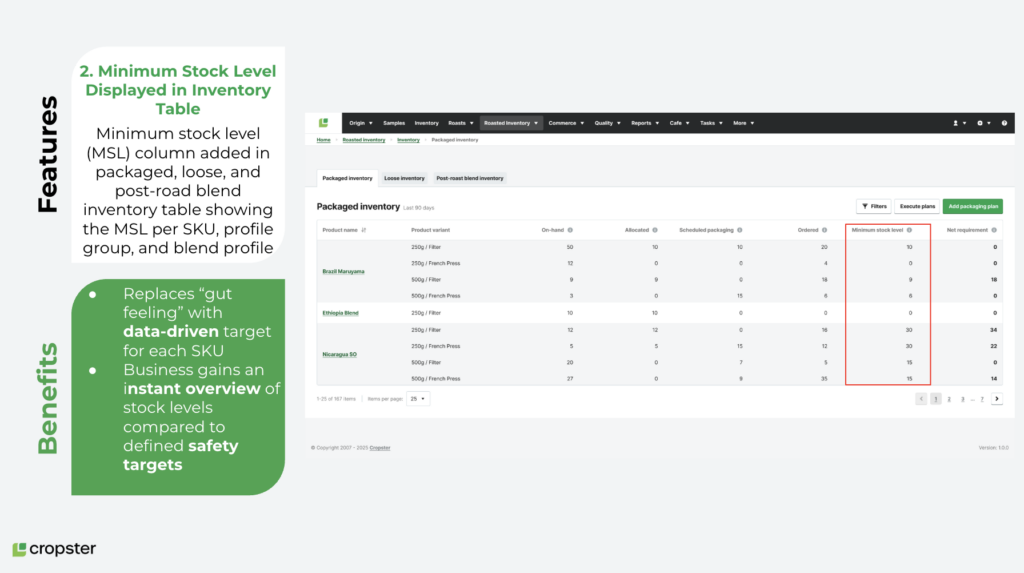
Minimum Stock Levels work across the full production chain. You can set them for packaged inventory, loose roasted inventory, and post-roast blends. You do not need to set them for everything on day one. Many roasteries start with their top sellers and work down from there.
How It Works in Practice
Ellis walked through the full workflow live. Setting a minimum stock level takes one field per variant. Once set, the inventory overview page shows on-hand stock, scheduled packaging, incoming orders, the minimum stock level floor, and the net requirement. All in one view.
From there, packaging plans are created directly from the net requirement number. No manual calculation. The system pre-fills the quantity. Once packaging plans are created, the loose inventory overview shows the roasting requirement automatically driven by the packaging plan, plus the loose minimum stock level. Everything flows downstream without anyone working out the math across different inventory types, removing a significant source of human error in the process.
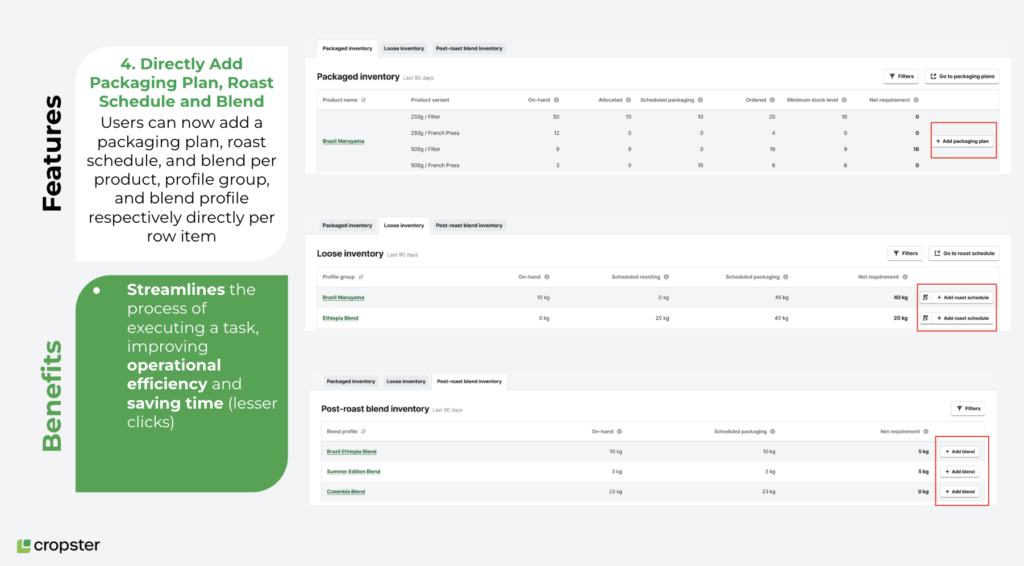
When orders come in, the same logic applies. The packaging tab in order fulfillment shows the net requirement per SKU, accounting for what has been ordered and the minimum stock level floor. One click creates the packaging plans. The production chain runs from there.
What This Is the Start Of
Ellis was clear that Minimum Stock Levels are not just a feature update. They are the first step toward demand-led production planning, where what gets roasted is determined by what is actually needed, not what someone thinks is needed. Better forecasting and seasonal trend visibility are coming next.
Minimum Stock Levels are available in the Cropster Scale package. If you do not find this function in your Cropster account, please contact our team, and we will help you get set up.
What Comes Next
Episode 3 is on June 10. Ellis returns to cover non-coffee inventory and Bills of Material in Cropster’s new Advanced Planning add-on, so bags, labels, valves, and consumables are managed in the same planning logic as roasted goods.
If you missed the full platform overview from Cropster CEO and Co-Founder Andreas Idl, Episode 1 is also available to watch.