The Infrastructure Problem Roasteries Keep Calling Admin
| Cropster
La Cabra roasts around 2.5 tons a week from Aarhus, holds a 10-day shelf life, and releases a new coffee most weeks. Orders close Monday and Wednesday for dispatch the following day. There is no slack in that. A planning error on Monday morning is not recoverable by Tuesday, and the coffee that misses the window is coffee they will not sell.
Most growing roasteries are running some version of that squeeze, usually without noticing when it arrived. It tends to show up around 70% of capacity. Below that line, the informal systems work, because there is enough slack in the week to absorb them. A missed number gets caught. A wrong count gets corrected before it matters. The person who holds it all together has time to hold it all together.
Past 70%, that slack is gone. The same systems are now load-bearing, and the same small errors reach the floor before anyone finds them. The spreadsheet that used to be a convenience is now the only place a critical number lives. The person who knows how everything connects is now a dependency the business cannot schedule around.
What makes this hard to fix is that nothing has failed. Nobody has been careless. There is only a number that should be better than it is, and no obvious place to look.
The distinction that matters is not how carefully the work gets done. It is whether the number moves on its own. When a roast is logged, a count is taken, or an order is placed, that information is needed somewhere else almost immediately: by the person planning next week, the person buying next season, the person answering a customer. Either it arrives there because the systems are connected, or it arrives because somebody carries it.
The second version is what gets filed under admin, and filing it there is why it never gets fixed. Admin is a category you absorb. Infrastructure is a category you decide on.
Some operations can see the cost, because they have made it countable. Grind in London, Solberg & Hansen in Oslo, Meron in Romania, La Cabra in Denmark, and Dak in Amsterdam each measure things most roasteries do not. What the measurements show is not that these businesses are exceptional. It is what a piece of work actually costs when somebody is counting it.
Here are the five places the money goes.
1. The forecast that lives outside the system
Every roastery buying green ahead of demand is making a bet. The size of that bet is set by a number, and the question worth asking is what that number is built from.
At Grind, Howard Gill manages 393 tons of contracted green coffee across an assortment of 10 to 16 coffees, much of it still at origin or in transit. To decide when to pull the next container, he takes 6 weeks of production data and extrapolates weekly usage for the house blends.
His position on where that data comes from is firm: financial systems derive production from sales revenue, and he treats the roasting record as the more reliable of the 2, because it starts from what came out of the machine rather than from what was invoiced.
Meron, which supplies its own network of cafes alongside its wholesale accounts, approaches it from consumption. The team tracks usage by category, milk drinks against espresso against filter, and compares the current period against the same period last year. That comparison tells the sourcing team which categories are moving before the buying season starts, and it comes out of the same reports the CEO and finance team already use.
Solberg & Hansen answers a different question with the same principle. They hold a database of more than 7,300 samples, so a decision on a lot from a given origin and producer can be checked against how comparable coffees have performed in their own roastery, not just against how they cupped on the table that morning.
None of these methods asks the buyer to remember anything. In each case, the information was generated somewhere else in the business, by someone doing a different job, and it reached the buying decision without anyone deciding to send it.
The alternative looks almost identical from the outside. Last season’s volume, plus a growth assumption, plus whatever the supplier suggests. The difference never announces itself. It shows up as a permanent gap between what you commit to and what you need. The container that arrives 3 weeks early and sits paid for. The lot you run short on and cover at spot price. The contract sized to last year rather than to next quarter’s actual demand curve.
None of those register as mistakes. They register as the cost of doing business, which is exactly why they never get examined.
2. Stock that is not where the system says it is
The number in the system stops being trusted long before anyone admits it.
It happens gradually. A count is a week old. Green in transit, green at an external warehouse, and green on hold sit outside it. Somebody plans against the figure anyway, then someone else checks physically because they need to be sure, and once one person has started checking, the system has become a suggestion. Production plans against one number, purchasing against another, and nobody notices until it produces a consequence. A lot is double-allocated. A blend component is short mid-week. A reconciliation shows the planning number has been wrong for 3 weeks.
The cost is not the discrepancy. It is every decision made in the interval before anyone found it.
What stops the drift is not vigilance. It is whether the count and the plan are looking at the same record. Meron tracks roughly 18 tons across 90 to 100 lots, active and unreleased, and the roasting team does not verify it physically. Every arrival is logged the day it lands, and that entry is the same one production plans against, sourcing reviews and finance reports from. There is no second version to reconcile.
La Cabra, a Danish roastery, arrives at the same place through obligation. Their organic certification requires documented movement of coffee through roasting, packing, and shipping, reviewed monthly by someone outside the business. The record has to hold up to inspection, which means it cannot be reconstructed after the fact.
3. The plan and the hand-off
An order does not arrive as a batch. Something has to turn one into the other, and in most roasteries that something is a person, chosen by proximity rather than by design.
That is what makes it expensive. When the hand-off has no owner, it is performed differently depending on who is there and how busy the day is. There is no version to improve, because there is no version. Errors surface downstream, where the cause is no longer traceable, and the fix is always the same: someone checks more carefully next time, which lasts until the next busy week.
The visible half of this cost is planning time. Ditte Laursen, La Cabra’s roastery manager, puts the difference between building the weekly plan in a spreadsheet and having it assembled from live order data at roughly one working day a week. On a 5-day week, that is 20% of a manager’s time, and none of it was going on roast profiles, cupping, or wholesale accounts. It went on moving numbers from where they were entered to where they were needed. La Cabra has doubled its volume in the last few years without adding to that planning load, which is the part worth noticing. A spreadsheet would have doubled with it.
At Dak, the order platforms and the production system do not share a view of what is committed. Rather than leave that gap to whoever notices it, the packing and dispatch teams reconcile the two and set the daily roast schedule themselves, so production is instructed by the people who own outbound commitments rather than assembled by roasters working backward from an order list. Running 70 batches a day, 7 days a week, they have no quiet day to catch an overselling error later.
Neither has eliminated the hand-off. Both have narrowed it to a defined point, with a named owner and a fixed method, which is what you do when two systems will not talk, and you need the gap to behave predictably anyway.
Industry benchmarks put manual data error rates around 5%, at an average cost of $53 per error to find and fix. Those are not alarming numbers alone. Applied across every order, every stock movement, and every label in a business shipping 7 days a week, they compound into a permanent operational tax.
There is a second effect that matters more as you grow. When planning is manual, it is specialized work that one or two people can do. When it is not, anyone in production can pick it up. That is the difference between a roastery that can take a week off and one that cannot.
4. Consistency that depends on who is on shift
This is the leak that gets classified as a quality issue and therefore never reaches the finance conversation. It should.
Solberg & Hansen produces 17 to 25 tons a week across 10,300 roasts a year, and cups every batch produced that day at 3 p.m. Simo Kristidhi, their production and logistics manager, tracks the percentage of roasts hitting every defined target simultaneously. A recent week came in at 89.2%, with 92% of individual targets met overall.
Grind holds tolerances of a quarter of a degree on end temperature and 10 seconds on total roast time, across seven roasters running two shifts, 7 a.m. to 3 p.m. and 1 p.m. to 9 p.m. Production cupping runs twice a week and covers every batch from the day before. Meron reports 95% of daily batches meeting every target while the volume machine runs 23 batches a day.
Dak shows the same principle without a headline number. At 70 batches a day, a lengthy quality form would stop the floor, so the check is reduced to one automatic threshold on weight loss. Batches inside it move to packing. Batches outside it get set aside, measured, and cupped, and the answer reaches the rest of the business immediately. They track no goal percentage at all, because their lineup changes weekly, and the figure would not mean much. The threshold still does its job.
In each case, the target sits in the same place as the result. A batch that misses is visible to the roaster, the quality lead, and whoever handles the account at the same moment, not after somebody notices and passes it on. The skill still belongs to the roaster. What changes is that consistency no longer depends on which roaster is holding it.
Without it, you find out consistency has slipped when a wholesale account mentions the coffee tastes different. That is usually two weeks after it started and one conversation before they begin sampling competitors.
Price the difference. A rejected batch is green, labor, packaging, and machine time. A quietly lost wholesale account is annual revenue. Neither appears in a line item called quality control.
5. The batch cost nobody has recalculated
Every price a roastery charges rests on a figure for what it costs to produce a kilo of roasted coffee. That figure gets set once, usually early, and then it ages quietly while green prices move, yields drift, and the product mix changes around it.
The question is where it comes from. Most business systems derive production from sales revenue, working backward from what was invoiced to estimate what must have been roasted. Howard Gill’s position on this is firm: he treats the roasting record as the more reliable of the two, because it starts from what actually came out of the machine. Where the two disagree, one of them is a calculation, and the other is a measurement, and it is worth knowing which is which before pricing against it.
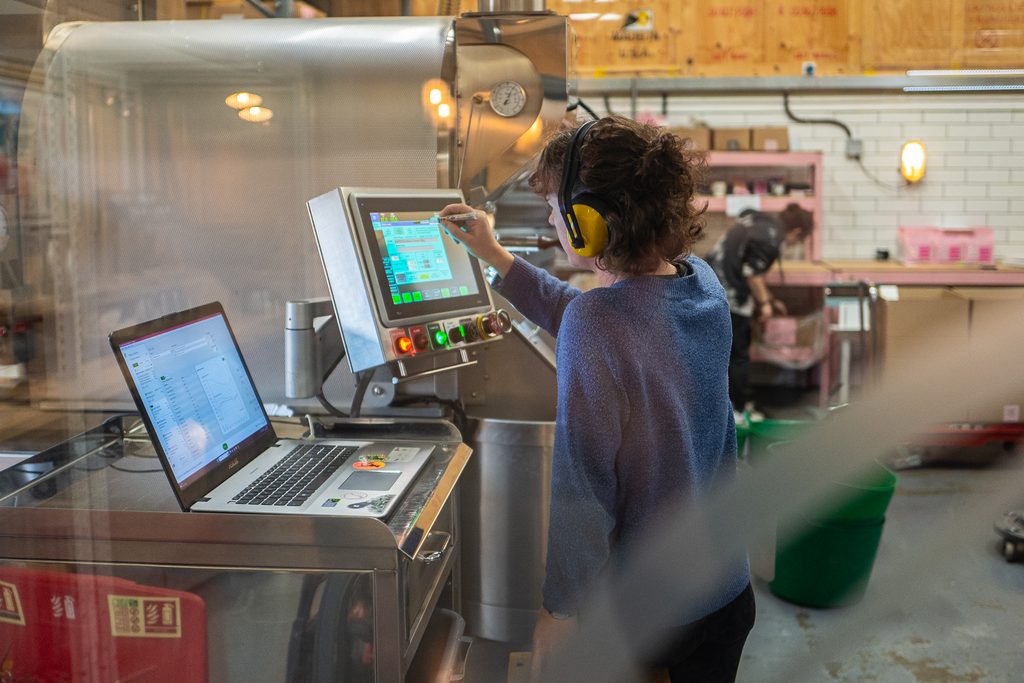
Dak measures it at the point it happens. The weight loss threshold that decides whether a batch passes quality control is the same number that determines how much roasted coffee comes out of each kilo of green. One measurement, taken on the floor, answers both a quality question and a cost question at once.
Meron closes the loop at the other end. Production data goes to the finance team and the CEO as categorized reports, which means the people setting prices are looking at what the roastery actually produced rather than at what the accounting system inferred.
Without that, the errors compound in a specific direction. Yield assumptions stay at the number someone set when the machine was new. Green cost stays at last season’s contract price. Blends get priced on component costs that have each moved a little. None of it is wrong enough to notice on any single invoice, which is precisely the problem: a margin that is two points thinner than you think it is looks exactly like a margin that is fine.
What connects all 5
Every roastery has at least one point where a person carries information from one place to another by hand. That is not a sign of a badly run business. It is what capable operators build when the data sits in one system and the decision that needs it lives in another.
What the operations above have in common is that they know where theirs are. Grind knows which decision runs on extrapolated production data and which record to trust when two systems disagree. La Cabra knows which orders are keyed by hand and why. Dak knows exactly which platforms have to be reconciled and who does it. Solberg & Hansen can name the part of their operation that still runs outside the system, and are working on it.
That is the whole difference. Not the absence of hand-offs, but knowing where they are, what they cost, and who owns them.
Cropster’s research puts the cost of manual data movement at 8.2 hours a week for a growing roastery, at a 5% error rate and an average of $53 per error to find and fix. Those figures understate the total, because they count only the transcription. They do not count the decisions delayed while someone assembles a number, the errors introduced in transit, the work that stops when the person is on vacation, or the growth ceiling created by a process only one person can run.
The question this changes
Notice how few of the five have a price on them.
There is one figure in this article that converts directly into money, and it belongs to La Cabra: a working day a week, 20% of a manager’s time, recovered. The other four leaks have no published cost, because almost nobody measures them. Not the roasteries, not their suppliers, and not the industry that writes about them.
That absence is the argument, not a hole in it. Costs that go unmeasured get classified by default, and the default is admin. Admin costs get managed. You absorb them, you delegate them, you accept them as the price of growth. Infrastructure costs get decided. You compare what they cost to leave alone against what they cost to fix, and you make a call with a number attached.
Most roasteries at 70% capacity have never made that comparison, because the losses have never been filed under a heading that would prompt it. They sit in five separate places, each small enough to tolerate, none of them owned by anyone in particular.
So the useful exercise is not finding a fix. It is putting a figure on each of the five, for your own operation, and seeing what the total looks like written down in one place. Not to justify a decision, but because you cannot decide about a cost you have never sized. Most roasteries have been carrying this one for years without ever having chosen to.
More on the business of running a roastery, straight to your inbox. Subscribe to the Cropster newsletter.