Your stock level is the wrong reason to buy green coffee
| Cropster
Imagine it is June, and the planning sheet says your Kenya is down to 6 weeks of cover. For most of what a roastery buys, that is the moment to reorder. Valves, bags, labels and boxes can be bought any week of the year, so a stock level is a reasonable trigger.
Green coffee does not work that way. Each origin can only be bought fresh, and with real choice, for a few months a year, and those months are set by the harvest, not by what is left in your warehouse. By the time the stock level tells you to buy, the window for that origin may already have closed.
Getting the timing wrong rarely shows up as one line in the accounts. It shows up as a swapped origin in a blend a wholesale customer notices, spot prices paid on coffee bought late, and cash tied up in coffee that landed months before it was needed.
The date to buy green coffee comes from the harvest. Planning starts from each origin’s buying window and works backwards to the roastery.
This is the month it starts. Harvest is beginning in Ethiopia, Kenya, and central Colombia, and Central America follows in November (Mercanta). Most of next year’s coffee gets committed over the coming winter, against a forecast built now.
Green coffee does not restock like everything else
Most origins are harvested once a year, and a few twice. The coffee from that harvest is sold, milled, and shipped over a few months, and then it is gone until the next one.
The usual rules of thumb work on cover and price. In Perfect Daily Grind, a green coffee trader suggests buying 3 to 6 months ahead when the market is high, and 6 to 9 months ahead when it is low. That is sound advice for cash flow and cover. It says nothing about when each origin can be bought.
Cover and timing are different questions. A roastery can have 5 healthy months of Kenya in May and still run short in the fall, because the main crop has already been sold and the next one does not land until the following spring.
4 dates that are easy to confuse
Every green coffee purchase has 4 dates attached to it. Most buying mistakes come from treating one as another.
- The date the coffee is picked.
- The date it can be bought.
- The date it lands.
- The date your stock runs low.
Picked, buyable, and landed are months apart. The International Coffee Organization (ICO) puts the usual lag between the start of a harvest and the first exports at 2 to 3 months (ICO). In Ethiopia, exports peak between April and July, months after picking ends (USDA FAS). None of this is news to a buyer. The problem is that the order still gets triggered by the fourth date.
None of the dates hold still. Brazil’s 2026 harvest ran late. By August 12, it was 90% complete, against a 5-year average of 94%, and the Arabica harvest was further behind (Barchart, citing Safras & Mercado). A late harvest moves every date after it, including the one you planned to buy on.
The fourth date is the only one that lives in the roastery. It is also the one that usually triggers the order.
Work backwards from the window
Take one origin and plan it backwards from the roastery. Kenya makes a clear example, because its selling season is public. Say you want fresh Kenyan main crop in the roastery by early summer.
When it lands. Kenyan main crop usually ships from February or March and reaches consuming markets from mid-April through May (Mercanta). All of these dates are estimates, and they move by region and by season.
How long it travels. That transit now includes the Red Sea diversion. UNCTAD notes that routing around the Cape of Good Hope usually adds more than 10 days to a voyage (BISI, citing UNCTAD).
When it can be bought. More than 90% of Kenyan coffee is sold through the weekly auctions of the Nairobi Coffee Exchange (USDA FAS). The main crop is picked from October to January, and its exports peak in February and March (Mercanta). By the time it lands in consuming markets, most of it has already been sold.
Read backwards, fresh Kenya in the roastery by early summer looks like this:
- June: in the roastery.
- Mid-April to May: landed.
- February to March: shipped, plus 10 days or more by the Cape route.
- January to March: bought at auction.
- Before January: volume decided.
By the time a June stock check flags the gap, the auctions for the main crop are over. There will still be Kenya on offer, from importers who bought ahead on their own account. But the choice is what they chose, at a price that includes holding it for you.
Experienced buyers already work this way. Covoya, a US importer, describes roasters who commit to coffees before they land, sometimes before they ship or are even harvested, on contracts subject to sample approval (Covoya).
The same arithmetic works for any origin. Start from the date you need the coffee, subtract transit and export time, and you reach the window. The volume decision sits before it.
Buy enough, but not too much
Thijs van Meurs spent 15 years in green buying and roasting in London and Amsterdam before joining Cropster. In the Beyond the Roast session, he put his hardest problem as a buyer simply: buy enough, but not too much.
His example is 2 containers due in November while a whole container of the same coffee is still in the warehouse. The new crop is fresh, the old crop is aging, and both are paid for. Buy too little and the gap gets filled at spot. Buy too much and the cash sits in green that loses quality every month it waits.
Holding both sides is the job of the green coffee planning sheet, which he called the biggest spreadsheet of all. The questions it has to answer show why:
- How much coffee do I have?
- Where is it?
- Is it on a container, or has it not left origin yet?
- Have I approved it?
- How much do I need?
- When does it arrive?
- How much old crop will I have left when the new crop lands?
Run your own sheet against them. Questions 1, 2 and 4 are about the warehouse. Questions 3, 6 and 7 are about the calendar. If your sheet answers the first group in seconds and the second takes an afternoon, it tracks stock well and plans purchases poorly.
Question 5 is the one the rest depend on. Grind, a UK roastery, forecasts 12 months ahead so it knows when to buy green before it runs out, according to Howard Gill, Grind’s Head of Coffee. That horizon covers about one full harvest cycle. The forecast has to reach past the next window.
When the calendar starts to cost money
Not every roastery needs this. Thijs draws the line in volume. At 200 kg a month, you can buy as you go. At 20,000 kg a month, a container arrives every month, and each one had to be decided months before.
Most roasteries sit between those numbers. A simpler test: if running out of one origin would mean changing a blend a wholesale customer buys every week, you are past the line.
Past that line, a purchase triggered by the stock level has a price, even when the coffee still arrives:
- A rushed purchase, from whatever is on offer the week you notice the gap.
- A swapped origin in a wholesale blend, and a conversation with the account about why it tastes different.
- Past-crop coffee. Green coffee keeps aging after it lands. A 2023 study in Scientific Reports found it aged fastest at 20 °C, the warmest of the 3 storage temperatures tested (Scientific Reports).
- Cash committed at the wrong time, either tied up in coffee that arrives too early or spent at spot prices on coffee bought too late.
Your calendar is someone else’s financing
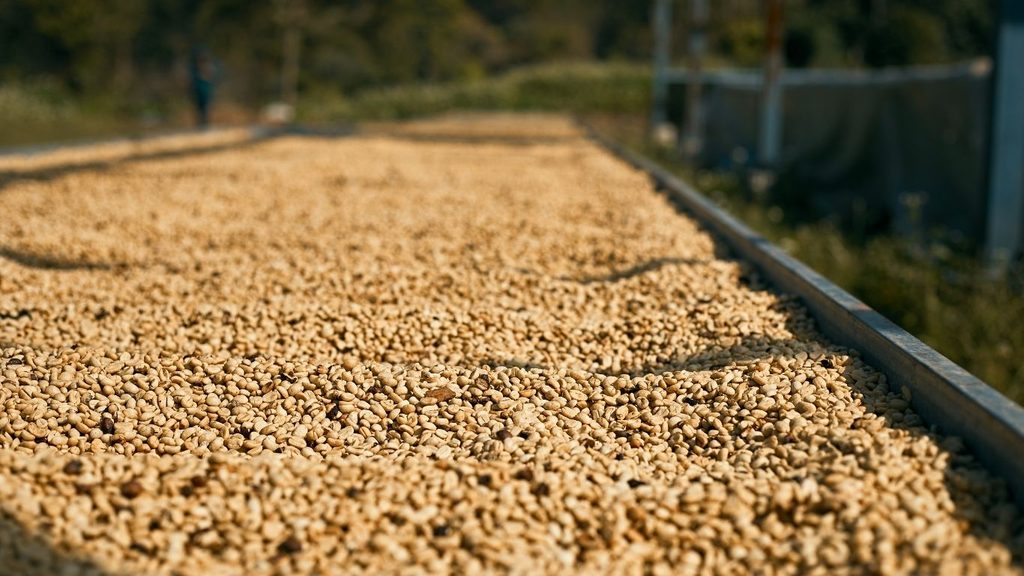
The calendar has a second side. When a roastery commits to volumes early, that commitment travels up through the importer and the exporter to the washing station. The station buys cherry from farmers every day of the harvest, and it finances that buying against the demand it expects or the provisional contracts it holds, according to former green buyer Christopher Feran.
A buyer who decides late leaves the station financing on a guess, in a chain where payment already takes 3 to 9 months to reach producers (VOCAL).
Early commitment carries risk on both sides. Coffee Intelligence points out that quality is unknown before harvest, and that crop failure can stop a producer from delivering. But a buyer who decides volumes before the window opens is one the people at origin can plan around.
Pick one origin
Every green buyer knows how much coffee is in the warehouse. The harder question is the one the calendar asks. For each origin you buy, how much will you need next year, and will you have decided before its window opens?
Choose one origin you buy every year. Write down the month its window opens, and the volume you will need from that harvest. If the second number is a guess, that is where planning starts.